API Reference
Package Layout
mitogen Package
On the Mitogen master, this is imported from mitogen/__init__.py as would
be expected. On the slave, it is built dynamically during startup.
-
mitogen.__version__= (0, 3, 5, 'dev0')¶ Library version as a tuple.
-
mitogen.is_master= True¶ This is
Falsein slave contexts. Previously it was used to prevent re-execution of__main__in single file programs, however that now happens automatically.
-
mitogen.context_id= 0¶ This is 0 in a master, otherwise it is the master-assigned ID unique to the slave context used for message routing.
-
mitogen.parent_id= None¶ This is
Nonein a master, otherwise it is the master-assigned ID unique to the slave’s parent context.
-
mitogen.parent_ids= []¶ This is an empty list in a master, otherwise it is a list of parent context IDs ordered from most direct to least direct.
-
mitogen.main(log_level='INFO', profiling=False)¶ Convenience decorator primarily useful for writing discardable test scripts.
In the master process, when func is defined in the
__main__module, arranges for func(router) to be invoked immediately, withmitogen.master.Routerconstruction and destruction handled just as inmitogen.utils.run_with_router(). In slaves, this function does nothing.- Parameters
log_level (str) – Logging package level to configure via
mitogen.utils.log_to_file().profiling (bool) – If
True, equivalent to settingmitogen.master.Router.profilingprior to router construction. This causes/tmpfiles to be created everywhere at the end of a successful run withcProfileoutput for every thread.
Example:
import mitogen
import requests

def get_url(url):
    return requests.get(url).text

@mitogen.main()
def main(router):
    z = router.ssh(hostname='k3')
    print(z.call(get_url, 'https://example.org/')))))
mitogen.core
This module implements most package functionality, but remains separate from non-essential code in order to reduce its size, since it is also serves as the bootstrap implementation sent to every new slave context.
-
@mitogen.core.takes_econtext¶ Decorator that marks a function or class method to automatically receive a kwarg named econtext, referencing the
mitogen.core.ExternalContextactive in the context in which the function is being invoked in. The decorator is only meaningful when the function is invoked viaCALL_FUNCTION.When the function is invoked directly, econtext must still be passed to it explicitly.
-
@mitogen.core.takes_router¶ Decorator that marks a function or class method to automatically receive a kwarg named router, referencing the
mitogen.core.Routeractive in the context in which the function is being invoked in. The decorator is only meaningful when the function is invoked viaCALL_FUNCTION.When the function is invoked directly, router must still be passed to it explicitly.
mitogen.master
This module implements functionality required by master processes, such as starting new contexts via SSH. Its size is also restricted, since it must be sent to any context that will be used to establish additional child contexts.
mitogen.parent
This module defines functionality common to master and parent processes. It is sent to any child context that is due to become a parent, due to recursive connection.
mitogen.fakessh
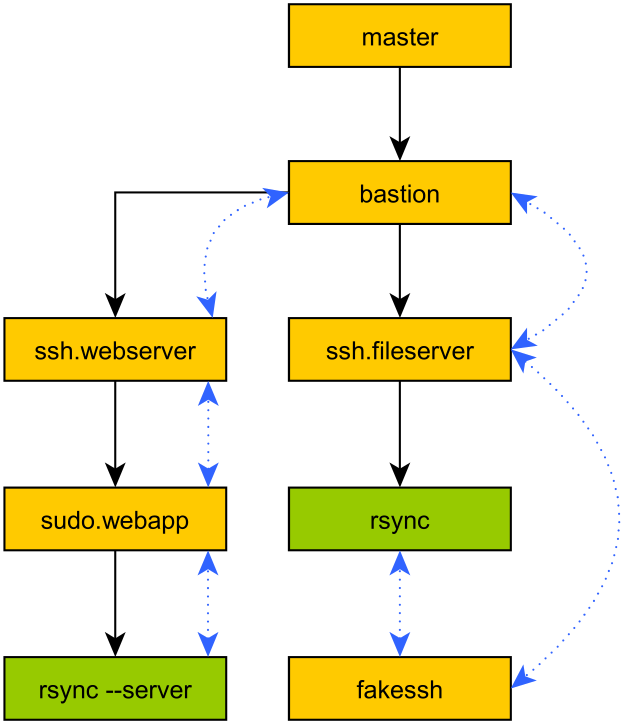
mitogen.fakessh is a stream implementation that starts a subprocess with
its environment modified such that PATH searches for ssh return a Mitogen
implementation of SSH. When invoked, this implementation arranges for the
command line supplied by the caller to be executed in a remote context, reusing
the parent context’s (possibly proxied) connection to that remote context.
This allows tools like rsync and scp to transparently reuse the connections
and tunnels already established by the host program to connect to a target
machine, without wasteful redundant SSH connection setup, 3-way handshakes, or
firewall hopping configurations, and enables these tools to be used in
impossible scenarios, such as over sudo with requiretty enabled.
The fake ssh command source is written to a temporary file on disk, and
consists of a copy of the mitogen.core source code (just like any
other child context), with a line appended to cause it to connect back to the
host process over an FD it inherits. As there is no reliance on an existing
filesystem file, it is possible for child contexts to use fakessh.
As a consequence of connecting back through an inherited FD, only one SSH invocation is possible, which is fine for tools like rsync, however in future this restriction will be lifted.
Sequence:
fakesshContext and Stream created by parent context. The stream’s buffer has a_fakessh_main()CALL_FUNCTIONenqueued.Target program (rsync/scp/sftp) invoked, which internally executes ssh from
PATH.
mitogen.corebootstrap begins, recovers the stream FD inherited via the target program, established itself as the fakessh context.
_fakessh_main()CALL_FUNCTIONis read by fakessh context,
sets up
IoPumpfor stdio, registers stdin_handle for local context.Enqueues
CALL_FUNCTIONfor_start_slave()invoked in target context,
the program from the ssh command line is started
sets up
IoPumpfor ssh command line process’s stdio pipesreturns (control_handle, stdin_handle) to
_fakessh_main()
_fakessh_main()receives control/stdin handles from from_start_slave(),
registers remote’s stdin_handle with local
IoPump.sends (“start”, local_stdin_handle) to remote’s control_handle
registers local
IoPumpwithmitogen.core.Broker.loops waiting for local stdout closed && remote stdout closed
_start_slave()control channel receives (“start”, stdin_handle),
registers remote’s stdin_handle with local
IoPumpregisters local
IoPumpwithmitogen.core.Broker.loops waiting for local stdout closed && remote stdout closed
-
mitogen.fakessh.run(dest, router, args, daedline=None, econtext=None)¶ Run the command specified by args such that
PATHsearches for SSH by the command will cause its attempt to use SSH to execute a remote program to be redirected to use mitogen to execute that program using the context dest instead.- Parameters
dest (mitogen.core.Context) – The destination context to execute the SSH command line in.
router (mitogen.core.Router) –
args – Command line arguments for local program, e.g.
['rsync', '/tmp', 'remote:/tmp']
- Returns
Exit status of the child process.
Message Class
-
class
mitogen.core.Message(**kwargs)¶ Messages are the fundamental unit of communication, comprising fields from the Stream Protocol header, an optional reference to the receiving
mitogen.core.Routerfor ingress messages, and helper methods for deserialization and generating replies.-
auth_id= None¶ Context ID under whose authority the message is acting. See Source Verification.
-
data= b''¶ Raw message data bytes.
-
classmethod
dead(reason=None, **kwargs)¶ Syntax helper to construct a dead message.
-
dst_id= None¶ Integer target context ID.
Routerdelivers messages locally when theirdst_idmatchesmitogen.context_id, otherwise they are routed up or downstream.
-
handle= None¶ Integer target handle in the destination context. This is one of the Standard Handles, or a dynamically generated handle used to receive a one-time reply, such as the return value of a function call.
-
property
is_dead¶ Trueifreply_tois set to the magic valueIS_DEAD, indicating the sender considers the channel dead. Dead messages can be raised in a variety of circumstances, seeIS_DEADfor more information.
-
classmethod
pickled(obj, **kwargs)¶ Construct a pickled message, setting
datato the serialization of obj, and setting remaining fields using kwargs.- Returns
The new message.
-
receiver= None¶ The
Receiverover which the message was last received. Part of themitogen.select.Selectinterface. Defaults toNone.
-
reply(msg, router=None, **kwargs)¶ Compose a reply to this message and send it using
router, or router isrouterisNone.
-
reply_to= None¶ Integer target handle to direct any reply to this message. Used to receive a one-time reply, such as the return value of a function call.
IS_DEADhas a special meaning when it appears in this field.
-
router= None¶ The
Routerresponsible for routing the message. This isNonefor locally originated messages.
-
src_id= None¶ Integer source context ID. Used as the target of replies if any are generated.
-
unpickle(throw=True, throw_dead=True)¶ Unpickle
data, optionally raising any exceptions present.- Parameters
throw_dead (bool) – If
True, raise exceptions, otherwise it is the caller’s responsibility.- Raises
CallError – The serialized data contained CallError exception.
ChannelError – The is_dead field was set.
-
Router Class
-
class
mitogen.core.Router(broker)¶ Route messages between contexts, and invoke local handlers for messages addressed to this context.
Router.route()straddles theBrokerthread and user threads, it is safe to call anywhere.Note: This is the somewhat limited core version of the Router class used by child contexts. The master subclass is documented below this one.
-
add_handler(fn, handle=None, persist=True, policy=None, respondent=None, overwrite=False)¶ Invoke fn(msg) on the
Brokerthread for each Message sent to handle from this context. Unregister after one invocation if persist isFalse. If handle isNone, a new handle is allocated and returned.- Parameters
handle (int) – If not
None, an explicit handle to register, usually one of themitogen.core.*constants. If unspecified, a new unused handle will be allocated.persist (bool) – If
False, the handler will be unregistered after a single message has been received.respondent (mitogen.core.Context) –
Context that messages to this handle are expected to be sent from. If specified, arranges for a dead message to be delivered to fn when disconnection of the context is detected.
In future respondent will likely also be used to prevent other contexts from sending messages to the handle.
policy (function) –
Function invoked as policy(msg, stream) where msg is a
mitogen.core.Messageabout to be delivered, and stream is themitogen.core.Streamon which it was received. The function must returnTrue, otherwise an error is logged and delivery is refused.Two built-in policy functions exist:
has_parent_authority(): requires the message arrived from a parent context, or a context acting with a parent context’s authority (auth_id).mitogen.parent.is_immediate_child(): requires the message arrived from an immediately connected child, for use in messaging patterns where either something becomes buggy or insecure by permitting indirect upstream communication.
In case of refusal, and the message’s
reply_tofield is nonzero, amitogen.core.CallErroris delivered to the sender indicating refusal occurred.overwrite (bool) – If
True, allow existing handles to be silently overwritten.
- Returns
handle, or if handle was
None, the newly allocated handle.- Raises
Error – Attemp to register handle that was already registered.
-
context_by_id(context_id, via_id=None, create=True, name=None)¶ Return or construct a
Contextgiven its ID. An internal mapping of ID to the canonicalContextrepresenting that ID, so that Signals can be raised.This may be called from any thread, lookup and construction are atomic.
-
context_class¶ The
mitogen.core.Contextsubclass to use when constructing newContextobjects inmyself()andcontext_by_id(). PermitsRoutersubclasses to extend theContextinterface, as done inmitogen.parent.Router.alias of
Context
-
del_handler(handle)¶ Remove the handle registered for handle
- Raises
KeyError – The handle wasn’t registered.
-
myself()¶ Return a
Contextreferring to the current process. SinceContextis serializable, this is convenient to use in remote function call parameter lists.
-
register(context, stream)¶ Register a newly constructed context and its associated stream, and add the stream’s receive side to the I/O multiplexer. This method remains public while the design has not yet settled.
-
route(msg)¶ Arrange for the
Messagemsg to be delivered to its destination using any relevant downstream context, or if none is found, by forwarding the message upstream towards the master context. If msg is destined for the local context, it is dispatched using the handles registered withadd_handler().This may be called from any thread.
-
stream_by_id(dst_id)¶ Return the
Streamthat should be used to communicate with dst_id. If a specific route for dst_id is not known, a reference to the parent context’s stream is returned. If the parent is disconnected, or when running in the master context, returnNoneinstead.This can be used from any thread, but its output is only meaningful from the context of the
Brokerthread, as disconnection or replacement could happen in parallel on the broker thread at any moment.
-
unidirectional= False¶ When
True, permit children to only communicate with the current context or a parent of the current context. Routing between siblings or children of parents is prohibited, ensuring no communication is possible between intentionally partitioned networks, such as when a program simultaneously manipulates hosts spread across a corporate and a production network, or production networks that are otherwise air-gapped.Sending a prohibited message causes an error to be logged and a dead message to be sent in reply to the errant message, if that message has
reply_toset.The value of
unidirectionalbecomes the default for thelocal()unidirectional parameter.
-
-
class
mitogen.parent.Router(broker)¶ -
add_route(target_id, stream)¶ Arrange for messages whose dst_id is target_id to be forwarded on a directly connected
Stream. Safe to call from any thread.This is called automatically by
RouteMonitorin response tomitogen.core.ADD_ROUTEmessages, but remains public while the design has not yet settled, and situations may arise where routing is not fully automatic.- Parameters
target_id (int) – Target context ID to add a route for.
stream (mitogen.core.Stream) – Stream over which messages to the target should be routed.
-
del_route(target_id)¶ Delete any route that exists for target_id. It is not an error to delete a route that does not currently exist. Safe to call from any thread.
This is called automatically by
RouteMonitorin response tomitogen.core.DEL_ROUTEmessages, but remains public while the design has not yet settled, and situations may arise where routing is not fully automatic.- Parameters
target_id (int) – Target context ID to delete route for.
-
disconnect(context)¶ Disconnect a context and forget its stream, assuming the context is directly connected.
-
get_streams()¶ Return an atomic snapshot of all streams in existence at time of call. This is safe to call from any thread.
-
-
class
mitogen.master.Router(broker=None)¶ Extend
mitogen.core.Routerwith functionality useful to masters, and child contexts who later become masters. Currently when this class is required, the target context’s router is upgraded at runtime.Note
You may construct as many routers as desired, and use the same broker for multiple routers, however usually only one broker and router need exist. Multiple routers may be useful when dealing with separate trust domains, for example, manipulating infrastructure belonging to separate customers or projects.
- Parameters
broker (mitogen.master.Broker) – Broker to use. If not specified, a private
Brokeris created.max_message_size (int) –
Override the maximum message size this router is willing to receive or transmit. Any value set here is automatically inherited by any children created by the router.
This has a liberal default of 128 MiB, but may be set much lower. Beware that setting it below 64KiB may encourage unexpected failures as parents and children can no longer route large Python modules that may be required by your application.
-
enable_debug()¶ Cause this context and any descendant child contexts to write debug logs to
/tmp/mitogen.<pid>.log.
-
get_stats()¶ Return performance data for the module responder.
- Returns
Dict containing keys:
get_module_count: Integer count of
mitogen.core.GET_MODULEmessages received.get_module_secs: Floating point total seconds spent servicing
mitogen.core.GET_MODULErequests.good_load_module_count: Integer count of successful
mitogen.core.LOAD_MODULEmessages sent.good_load_module_size: Integer total bytes sent in
mitogen.core.LOAD_MODULEmessage payloads.bad_load_module_count: Integer count of negative
mitogen.core.LOAD_MODULEmessages sent.- minify_secs: CPU seconds spent minifying modules marked
minify-safe.
-
profiling= False¶ When
True, cause the broker thread and any subsequent broker and main threads existing in any child to write/tmp/mitogen.stats.<pid>.<thread_name>.logcontaining acProfiledump on graceful exit. Must be set prior to construction of anyBroker, e.g. via:mitogen.master.Router.profiling = True
Connection Methods
-
Router.buildah(container=None, buildah_path=None, username=None, **kwargs)¶ Construct a context on the local machine over a
buildahinvocation. Accepts all parameters accepted bylocal(), in addition to:
-
Router.fork(on_fork=None, on_start=None, debug=False, profiling=False, via=None)¶ Construct a context on the local machine by forking the current process. The forked child receives a new identity, sets up a new broker and router, and responds to function calls identically to children created using other methods.
The use of this method is strongly discouraged. It requires Python 2.6 or newer, as older Pythons made no effort to reset threading state upon fork.
For long-lived processes,
local()is always better as it guarantees a pristine interpreter state that inherited little from the parent. Forking should only be used in performance-sensitive scenarios where short-lived children must be spawned to isolate potentially buggy code, and only after accounting for all the bad things possible as a result of, at a minimum:Files open in the parent remaining open in the child, causing the lifetime of the underlying object to be extended indefinitely.
From the perspective of external components, this is observable in the form of pipes and sockets that are never closed, which may break anything relying on closure to signal protocol termination.
Descriptors that reference temporary files will not have their disk space reclaimed until the child exits.
Third party package state, such as urllib3’s HTTP connection pool, attempting to write to file descriptors shared with the parent, causing random failures in both parent and child.
UNIX signal handlers installed in the parent process remaining active in the child, despite associated resources, such as service threads, child processes, resource usage counters or process timers becoming absent or reset in the child.
Library code that makes assumptions about the process ID remaining unchanged, for example to implement inter-process locking, or to generate file names.
Anonymous
MAP_PRIVATEmemory mappings whose storage requirement doubles as either parent or child dirties their pages.File-backed memory mappings that cannot have their space freed on disk due to the mapping living on in the child.
Difficult to diagnose memory usage and latency spikes due to object graphs becoming unreferenced in either parent or child, causing immediate copy-on-write to large portions of the process heap.
Locks held in the parent causing random deadlocks in the child, such as when another thread emits a log entry via the
loggingpackage concurrent to another thread callingfork(), or when a C extension module calls the C library allocator, or when a thread is using the C library DNS resolver, for example viasocket.gethostbyname().Objects existing in Thread-Local Storage of every non-
fork()thread becoming permanently inaccessible, and never having their object destructors called, including TLS usage by native extension code, triggering many new variants of all the issues above.Pseudo-Random Number Generator state that is easily observable by network peers to be duplicate, violating requirements of cryptographic protocols through one-time state reuse. In the worst case, children continually reuse the same state due to repeatedly forking from a static parent.
fork()cleans up Mitogen-internal objects, in addition to locks held by theloggingpackage, reseedsrandom.random(), and the OpenSSL PRNG viassl.RAND_add(), but only if thesslmodule is already loaded. You must arrange for your program’s state, including any third party packages in use, to be cleaned up by specifying an on_fork function.The associated stream implementation is
mitogen.fork.Stream.- Parameters
on_fork (function) – Function invoked as on_fork() from within the child process. This permits supplying a program-specific cleanup function to break locks and close file descriptors belonging to the parent from within the child.
on_start (function) – Invoked as on_start(econtext) from within the child process after it has been set up, but before the function dispatch loop starts. This permits supplying a custom child main function that inherits rich data structures that cannot normally be passed via a serialization.
via (mitogen.core.Context) – Same as the via parameter for
local().profiling (bool) – Same as the profiling parameter for
local().
-
Router.local(remote_name=None, python_path=None, debug=False, connect_timeout=None, profiling=False, via=None)¶ Construct a context on the local machine as a subprocess of the current process. The associated stream implementation is
mitogen.master.Stream.- Parameters
remote_name (str) –
The
argv[0]suffix for the new process. If remote_name istest, the new processargv[0]will bemitogen:test.If unspecified, defaults to
<username>@<hostname>:<pid>.This variable cannot contain slash characters, as the resulting
argv[0]must be presented in such a way as to allow Python to determine its installation prefix. This is required to support virtualenv.python_path (str|list) –
String or list path to the Python interpreter to use for bootstrap. Defaults to
sys.executablefor local connections, andpythonfor remote connections.It is possible to pass a list to invoke Python wrapped using another tool, such as
["/usr/bin/env", "python"].debug (bool) – If
True, arrange for debug logging (enable_debug()) to be enabled in the new context. AutomaticallyTruewhenenable_debug()has been called, but may be used selectively otherwise.unidirectional (bool) – If
True, arrange for the child’s router to be constructed withunidirectional routingenabled. AutomaticallyTruewhen it was enabled for this router, but may still be explicitly set toFalse.connect_timeout (float) – Fractional seconds to wait for the subprocess to indicate it is healthy. Defaults to 30 seconds.
profiling (bool) – If
True, arrange for profiling (profiling) to be enabled in the new context. AutomaticallyTruewhenprofilingisTrue, but may be used selectively otherwise.via (mitogen.core.Context) –
If not
None, arrange for construction to occur via RPCs made to the context via, and forADD_ROUTEmessages to be generated as appropriate.# SSH to the remote machine. remote_machine = router.ssh(hostname='mybox.com') # Use the SSH connection to create a sudo connection. remote_root = router.sudo(username='root', via=remote_machine)
-
Router.doas(username=None, password=None, doas_path=None, password_prompt=None, incorrect_prompts=None, **kwargs)¶ Construct a context on the local machine over a
doasinvocation. Thedoasprocess is started in a newly allocated pseudo-terminal, and supports typing interactive passwords.Accepts all parameters accepted by
local(), in addition to:- Parameters
username (str) – Username to use, defaults to
root.password (str) – The account password to use if requested.
doas_path (str) – Filename or complete path to the
doasbinary.PATHwill be searched if given as a filename. Defaults todoas.password_prompt (bytes) – A string that indicates
doasis requesting a password. Defaults toPassword:.incorrect_prompts (list) – List of bytestrings indicating the password is incorrect. Defaults to (b”doas: authentication failed”).
- Raises
mitogen.doas.PasswordError – A password was requested but none was provided, the supplied password was incorrect, or the target account did not exist.
-
Router.docker(container=None, image=None, docker_path=None, **kwargs)¶ Construct a context on the local machine within an existing or temporary new Docker container using the
dockerprogram. One of container or image must be specified.Accepts all parameters accepted by
local(), in addition to:- Parameters
container (str) – Existing container to connect to. Defaults to
None.username (str) – Username within the container to
setuid()to. Defaults toNone, which Docker interprets asroot.image (str) – Image tag to use to construct a temporary container. Defaults to
None.docker_path (str) – Filename or complete path to the Docker binary.
PATHwill be searched if given as a filename. Defaults todocker.
-
Router.jail(container, jexec_path=None, **kwargs)¶ Construct a context on the local machine within a FreeBSD jail using the
jexecprogram.Accepts all parameters accepted by
local(), in addition to:- Parameters
container (str) – Existing container to connect to. Defaults to
None.username (str) – Username within the container to
setuid()to. Defaults toNone, whichjexecinterprets asroot.jexec_path (str) – Filename or complete path to the
jexecbinary.PATHwill be searched if given as a filename. Defaults to/usr/sbin/jexec.
-
Router.kubectl(pod, kubectl_path=None, kubectl_args=None, **kwargs)¶ Construct a context in a container via the Kubernetes
kubectlprogram.Accepts all parameters accepted by
local(), in addition to:
-
Router.lxc(container, lxc_attach_path=None, **kwargs)¶ Construct a context on the local machine within an LXC classic container using the
lxc-attachprogram.Accepts all parameters accepted by
local(), in addition to:
-
Router.lxd(container, lxc_path=None, **kwargs)¶ Construct a context on the local machine within a LXD container using the
lxcprogram.Accepts all parameters accepted by
local(), in addition to:
-
Router.podman(container=None, podman_path=None, username=None, **kwargs)¶ Construct a context on the local machine over a
podmaninvocation. Accepts all parameters accepted bylocal(), in addition to:
-
Router.setns(container, kind, username=None, docker_path=None, lxc_info_path=None, machinectl_path=None, **kwargs)¶ Construct a context in the style of
local(), but change the active Linux process namespaces via calls to setns(2) before executing Python.The namespaces to use, and the active root file system are taken from the root PID of a running Docker, LXC, LXD, or systemd-nspawn container.
The setns method depends on the built-in
ctypesmodule, and thus does not support Python 2.4.A program is required only to find the root PID, after which management of the child Python interpreter is handled directly.
- Parameters
container (str) – Container to connect to.
kind (str) – One of
docker,lxc,lxdormachinectl.username (str) – Username within the container to
setuid()to. Defaults toroot.docker_path (str) – Filename or complete path to the Docker binary.
PATHwill be searched if given as a filename. Defaults todocker.lxc_path (str) – Filename or complete path to the LXD
lxcbinary.PATHwill be searched if given as a filename. Defaults tolxc.lxc_info_path (str) – Filename or complete path to the LXC
lxc-infobinary.PATHwill be searched if given as a filename. Defaults tolxc-info.machinectl_path (str) – Filename or complete path to the
machinectlbinary.PATHwill be searched if given as a filename. Defaults tomachinectl.
-
Router.su(username=None, password=None, su_path=None, password_prompt=None, incorrect_prompts=None, **kwargs)¶ Construct a context on the local machine over a
suinvocation. Thesuprocess is started in a newly allocated pseudo-terminal, and supports typing interactive passwords.Accepts all parameters accepted by
local(), in addition to:- Parameters
username (str) – Username to pass to
su, defaults toroot.password (str) – The account password to use if requested.
su_path (str) – Filename or complete path to the
subinary.PATHwill be searched if given as a filename. Defaults tosu.password_prompt (bytes) – The string that indicates
suis requesting a password. Defaults toPassword:.incorrect_prompts (str) – Strings that signal the password is incorrect. Defaults to (“su: sorry”, “su: authentication failure”).
- Raises
mitogen.su.PasswordError – A password was requested but none was provided, the supplied password was incorrect, or (on BSD) the target account did not exist.
-
Router.sudo(username=None, sudo_path=None, password=None, **kwargs)¶ Construct a context on the local machine over a
sudoinvocation. Thesudoprocess is started in a newly allocated pseudo-terminal, and supports typing interactive passwords.Accepts all parameters accepted by
local(), in addition to:- Parameters
username (str) – Username to pass to sudo as the
-uparameter, defaults toroot.sudo_path (str) – Filename or complete path to the sudo binary.
PATHwill be searched if given as a filename. Defaults tosudo.password (str) – The password to use if/when sudo requests it. Depending on the sudo configuration, this is either the current account password or the target account password.
mitogen.sudo.PasswordErrorwill be raised if sudo requests a password but none is provided.set_home (bool) – If
True, requestsudoset theHOMEenvironment variable to match the target UNIX account.preserve_env (bool) – If
True, requestsudoto preserve the environment of the parent process.selinux_type (str) – If not
None, the SELinux security context to use.sudo_args (list) – Arguments in the style of
sys.argvthat would normally be passed tosudo. The arguments are parsed in-process to set equivalent parameters. Re-parsing ensures unsupported options causemitogen.core.StreamErrorto be raised, and that attributes of the stream match the actual behaviour ofsudo.
-
Router.ssh(hostname, username=None, ssh_path=None, ssh_args=None, port=None, check_host_keys='enforce', password=None, identity_file=None, identities_only=True, compression=True, **kwargs)¶ Construct a remote context over an OpenSSH
sshinvocation.The
sshprocess is started in a newly allocated pseudo-terminal to support typing interactive passwords and responding to prompts, if a password is specified, or check_host_keys=accept. In other scenarios,BatchModeis enabled and no PTY is allocated. For many-target configurations, both options should be avoided as most systems have a conservative limit on the number of pseudo-terminals that may exist.Accepts all parameters accepted by
local(), in addition to:- Parameters
username (str) – The SSH username; default is unspecified, which causes SSH to pick the username to use.
ssh_path (str) – Absolute or relative path to
ssh. Defaults tossh.ssh_args (list) – Additional arguments to pass to the SSH command.
port (int) – Port number to connect to; default is unspecified, which causes SSH to pick the port number.
check_host_keys (str) –
Specifies the SSH host key checking mode. Defaults to
enforce.ignore: no host key checking is performed. Connections never fail due to an unknown or changed host key.accept: known hosts keys are checked to ensure they match, new host keys are automatically accepted and verified in future connections.enforce: known host keys are checked to ensure they match, unknown hosts cause a connection failure.
password (str) – Password to type if/when
sshrequests it. If not specified and a password is requested,mitogen.ssh.PasswordErroris raised.identity_file (str) –
Path to an SSH private key file to use for authentication. Default is unspecified, which causes SSH to pick the identity file.
When this option is specified, only identity_file will be used by the SSH client to perform authenticaion; agent authentication is automatically disabled, as is reading the default private key from
~/.ssh/id_rsa, or~/.ssh/id_dsa.identities_only (bool) – If
Trueand a password or explicit identity file is specified, instruct the SSH client to disable any authentication identities inherited from the surrounding environment, such as those loaded in any runningssh-agent, or default key files present in~/.ssh. This ensures authentication attempts only occur using the supplied password or SSH key.compression (bool) – If
True, enablesshcompression support. Compression has a minimal effect on the size of modules transmitted, as they are already compressed, however it has a large effect on every remaining message in the otherwise uncompressed stream protocol, such as function call arguments and return values.ssh_debug_level (int) – Optional integer 0..3 indicating the SSH client debug level.
- Raises
mitogen.ssh.PasswordError – A password was requested but none was specified, or the specified password was incorrect.
mitogen.ssh.HostKeyError – When check_host_keys is set to either
accept, indicates a previously recorded key no longer matches the remote machine. When set toenforce, as above, but additionally indicates no previously recorded key exists for the remote machine.
Context Class
-
class
mitogen.core.Context(router, context_id, name=None)¶ Represent a remote context regardless of the underlying connection method. Context objects are simple facades that emit messages through an associated router, and have Signals raised against them in response to various events relating to the context.
Note: This is the somewhat limited core version, used by child contexts. The master subclass is documented below this one.
Contexts maintain no internal state and are thread-safe.
Prefer
Router.context_by_id()over constructing context objects explicitly, as that method is deduplicating, and returns the only context instance Signals will be raised on.- Parameters
router (mitogen.core.Router) – Router to emit messages through.
context_id (int) – Context ID.
name (str) – Context name.
-
send(msg)¶ Arrange for msg to be delivered to this context.
dst_idis set to the target context ID.- Parameters
msg (Message) – Message.
-
send_async(msg, persist=False)¶ Arrange for msg to be delivered to this context, with replies directed to a newly constructed receiver.
dst_idis set to the target context ID, andreply_tois set to the newly constructed receiver’s handle.- Parameters
persist (bool) – If
False, the handler will be unregistered after a single message has been received.msg (mitogen.core.Message) – The message.
- Returns
Receiverconfigured to receive any replies sent to the message’s reply_to handle.
-
send_await(msg, deadline=None)¶ Like
send_async(), but expect a single reply (persist=False) delivered within deadline seconds.- Parameters
msg (mitogen.core.Message) – The message.
deadline (float) – If not
None, seconds before timing out waiting for a reply.
- Returns
Deserialized reply.
- Raises
TimeoutError – No message was received and deadline passed.
-
class
mitogen.parent.Context(*args, **kwargs)¶ Extend
mitogen.core.Contextwith functionality useful to masters, and child contexts who later become parents. Currently when this class is required, the target context’s router is upgraded at runtime.-
call(fn, *args, **kwargs)¶ See
CallChain.call().
-
call_async(fn, *args, **kwargs)
-
call_chain_class¶ A
CallChaininstance constructed by default, with pipelining disabled.call(),call_async()andcall_no_reply()use this instance.alias of
CallChain
-
call_no_reply(fn, *args, **kwargs)
-
shutdown(wait=False)¶ Arrange for the context to receive a
SHUTDOWNmessage, triggering graceful shutdown.Due to a lack of support for timers, no attempt is made yet to force terminate a hung context using this method. This will be fixed shortly.
-
-
class
mitogen.parent.CallChain(context, pipelined=False)¶ Deliver
mitogen.core.CALL_FUNCTIONmessages to a target context, optionally threading related calls so an exception in an earlier call cancels subsequent calls.- Parameters
context (mitogen.core.Context) – Target context.
pipelined (bool) – Enable pipelining.
call(),call_no_reply()andcall_async()normally issue calls and produce responses with no memory of prior exceptions. If a call made withcall_no_reply()fails, the exception is logged to the target context’s logging framework.Pipelining
When pipelining is enabled, if an exception occurs during a call, subsequent calls made by the same
CallChainfail with the same exception, including those already in-flight on the network, and no further calls execute untilreset()is invoked.No exception is logged for calls made with
call_no_reply(), instead the exception is saved and reported as the result of subsequentcall()orcall_async()calls.Sequences of asynchronous calls can be made without wasting network round-trips to discover if prior calls succeed, and chains originating from multiple unrelated source contexts may overlap concurrently at a target context without interference.
In this example, 4 calls complete in one round-trip:
chain = mitogen.parent.CallChain(context, pipelined=True)
chain.call_no_reply(os.mkdir, '/tmp/foo')

# If previous mkdir() failed, this never runs:
chain.call_no_reply(os.mkdir, '/tmp/foo/bar')

# If either mkdir() failed, this never runs, and the exception is
# asynchronously delivered to the receiver.
recv = chain.call_async(subprocess.check_output, '/tmp/foo')

# If anything so far failed, this never runs, and raises the exception.
chain.call(do_something)

# If this code was executed, the exception would also be raised.
if recv.get().unpickle() == 'baz':
    pass
When pipelining is enabled,
reset()must be invoked to ensure any exception is discarded, otherwise unbounded memory usage is possible in long-running programs. The context manager protocol is supported to ensurereset()is always invoked:with mitogen.parent.CallChain(context, pipelined=True) as chain: chain.call_no_reply(...) chain.call_no_reply(...) chain.call_no_reply(...) chain.call(...) # chain.reset() automatically invoked.
-
call(fn, *args, **kwargs)¶ Like
call_async(), but block until the return value is available. Equivalent to:call_async(fn, *args, **kwargs).get().unpickle()
- Returns
The function’s return value.
- Raises
mitogen.core.CallError – An exception was raised in the remote context during execution.
-
call_async(fn, *args, **kwargs)¶ Arrange for fn(*args, **kwargs) to be invoked on the context’s main thread.
- Parameters
fn –
A free function in module scope or a class method of a class directly reachable from module scope:
# mymodule.py

def my_func():
    '''A free function reachable as mymodule.my_func'''

class MyClass:
    @classmethod
    def my_classmethod(cls):
        '''Reachable as mymodule.MyClass.my_classmethod'''

    def my_instancemethod(self):
        '''Unreachable: requires a class instance!'''

    class MyEmbeddedClass:
        @classmethod
        def my_classmethod(cls):
            '''Not directly reachable from module scope!'''
args (tuple) – Function arguments, if any. See RPC Serialization Rules for permitted types.
kwargs (dict) – Function keyword arguments, if any. See RPC Serialization Rules for permitted types.
- Returns
mitogen.core.Receiverconfigured to receive the result of the invocation:recv = context.call_async(os.check_output, 'ls /tmp/') try: # Prints output once it is received. msg = recv.get() print(msg.unpickle()) except mitogen.core.CallError, e: print('Call failed:', str(e))
Asynchronous calls may be dispatched in parallel to multiple contexts and consumed as they complete using
mitogen.select.Select.
-
call_no_reply(fn, *args, **kwargs)¶ Like
call_async(), but do not wait for a return value, and inform the target context no reply is expected. If the call fails and pipelining is disabled, the exception will be logged to the target context’s logging framework.
-
reset()¶ Instruct the target to forget any related exception.
Receiver Class
-
class
mitogen.core.Receiver(router, handle=None, persist=True, respondent=None, policy=None, overwrite=False)¶ Receivers maintain a thread-safe queue of messages sent to a handle of this context from another context.
- Parameters
router (mitogen.core.Router) – Router to register the handler on.
handle (int) – If not
None, an explicit handle to register, otherwise an unused handle is chosen.persist (bool) – If
False, unregister the handler after one message is received. Single-message receivers are intended for RPC-like transactions, such as in the case ofmitogen.parent.Context.call_async().respondent (mitogen.core.Context) – Context this receiver is receiving from. If not
None, arranges for the receiver to receive a dead message if messages can no longer be routed to the context due to disconnection, and ignores messages that did not originate from the respondent context.
-
close()¶ Unregister the receiver’s handle from its associated router, and cause
ChannelErrorto be raised in any thread waiting inget()on this receiver.
-
empty()¶ Return size() == 0.
Deprecated since version 0.2.8: Use
size()instead.- Raises
LatchError – The latch has already been marked closed.
-
get(timeout=None, block=True, throw_dead=True)¶ Sleep waiting for a message to arrive on this receiver.
- Parameters
timeout (float) – If not
None, specifies a timeout in seconds.- Raises
mitogen.core.ChannelError – The remote end indicated the channel should be closed, communication with it was lost, or
close()was called in the local process.mitogen.core.TimeoutError – Timeout was reached.
- Returns
Messagethat was received.
-
handle= None¶ The handle.
-
notify= None¶ If not
None, a function invoked as notify(receiver) after a message has been received. The function is invoked onBrokerthread, therefore it must not block. Used bymitogen.select.Selectto efficiently implement waiting on multiple event sources.
-
size()¶ Return the number of items currently buffered.
As with
Queue.Queue, 0 may be returned even though a subsequent call toget()will succeed, since a message may be posted at any moment betweensize()andget().As with
Queue.Queue, >0 may be returned even though a subsequent call toget()will block, since another waiting thread may be woken at any moment betweensize()andget().- Raises
LatchError – The underlying latch has already been marked closed.
-
to_sender()¶ Return a
Senderconfigured to deliver messages to this receiver. As senders are serializable, this makes it convenient to pass (context_id, handle) pairs around:def deliver_monthly_report(sender): for line in open('monthly_report.txt'): sender.send(line) sender.close() @mitogen.main() def main(router): remote = router.ssh(hostname='mainframe') recv = mitogen.core.Receiver(router) remote.call(deliver_monthly_report, recv.to_sender()) for msg in recv: print(msg)
Sender Class
-
class
mitogen.core.Sender(context, dst_handle)¶ Senders are used to send pickled messages to a handle in another context, it is the inverse of
mitogen.core.Receiver.Senders may be serialized, making them convenient to wire up data flows. See
mitogen.core.Receiver.to_sender()for more information.- Parameters
context (mitogen.core.Context) – Context to send messages to.
dst_handle (int) – Destination handle to send messages to.
-
close()¶ Send a dead message to the remote, causing
ChannelError()to be raised in any waiting thread.
-
send(data)¶ Send data to the remote end.
Select Class
-
class
mitogen.select.Event¶ Represents one selected event.
-
data= None¶ The
mitogen.core.Messagedelivered to a receiver, or the object posted to a latch.
-
source= None¶ The first Receiver or Latch the event traversed.
-
-
class
mitogen.select.Select(receivers=(), oneshot=True)¶ Support scatter/gather asynchronous calls and waiting on multiple
receivers,channels,latches, andsub-selects.If oneshot is
True, then remove each receiver as it yields a result; since__iter__()terminates once the final receiver is removed, this makes it convenient to respond to calls made in parallel:total = 0 recvs = [c.call_async(long_running_operation) for c in contexts] for msg in mitogen.select.Select(recvs): print('Got %s from %s' % (msg, msg.receiver)) total += msg.unpickle() # Iteration ends when last Receiver yields a result. print('Received total %s from %s receivers' % (total, len(recvs)))
Selectmay drive a long-running scheduler:with mitogen.select.Select(oneshot=False) as select: while running(): for msg in select: process_result(msg.receiver.context, msg.unpickle()) for context, workfunc in get_new_work(): select.add(context.call_async(workfunc))
Selectmay be nested:subselects = [ mitogen.select.Select(get_some_work()), mitogen.select.Select(get_some_work()), mitogen.select.Select([ mitogen.select.Select(get_some_work()), mitogen.select.Select(get_some_work()) ]) ] for msg in mitogen.select.Select(selects): print(msg.unpickle())
Selectmay be used to mix inter-thread and inter-process IO:latch = mitogen.core.Latch() start_thread(latch) recv = remote_host.call_async(os.getuid) sel = Select([latch, recv]) event = sel.get_event() if event.source is latch: # woken by a local thread else: # woken by function call result
-
add(recv)¶ Add a
mitogen.core.Receiver,Selectormitogen.core.Latchto the select.- Raises
mitogen.select.Error – An attempt was made to add a
Selectto which this select is indirectly a member of.
-
classmethod
all(receivers)¶ Take an iterable of receivers and retrieve a
Messagefrom each, returning the result of callingMessage.unpickle()on each in turn. Results are returned in the order they arrived.This is sugar for handling batch
Context.call_asyncinvocations:print('Total disk usage: %.02fMiB' % (sum( mitogen.select.Select.all( context.call_async(get_disk_usage) for context in contexts ) / 1048576.0 ),))
However, unlike in a naive comprehension such as:
recvs = [c.call_async(get_disk_usage) for c in contexts]
sum(recv.get().unpickle() for recv in recvs)
Result processing happens in the order results arrive, rather than the order requests were issued, so
all()should always be faster.
-
close()¶ Remove the select’s notifier function from each registered receiver, mark the associated latch as closed, and cause any thread currently sleeping in
get()to be woken withmitogen.core.LatchError.This is necessary to prevent memory leaks in long-running receivers. It is called automatically when the Python
withstatement is used.
-
get(timeout=None, block=True)¶ Call get_event(timeout, block) returning
Event.dataof the first available event.
-
get_event(timeout=None, block=True)¶ Fetch the next available
Eventfrom any source, or raisemitogen.core.TimeoutErrorif no value is available within timeout seconds.On success, the message’s
receiverattribute is set to the receiver.- Parameters
timeout (float) – Timeout in seconds.
block (bool) – If
False, immediately raisemitogen.core.TimeoutErrorif the select is empty.
- Returns
- Raises
mitogen.core.TimeoutError – Timeout was reached.
mitogen.core.LatchError –
close()has been called, and the underlying latch is no longer valid.
-
iter_data()¶ Yield
Event.datauntil no receivers remain in the select, either because oneshot isTrue, or each receiver was explicitly removed viaremove().__iter__()is an alias foriter_data(), allowing loops like:for msg in Select([recv1, recv2]): print msg.unpickle()
-
remove(recv)¶ Remove an object from from the select. Note that if the receiver has notified prior to
remove(), it will still be returned by a subsequentget(). This may change in a future version.
-
size()¶ Return the number of items currently buffered.
As with
Queue.Queue, 0 may be returned even though a subsequent call toget()will succeed, since a message may be posted at any moment betweensize()andget().As with
Queue.Queue, >0 may be returned even though a subsequent call toget()will block, since another waiting thread may be woken at any moment betweensize()andget().
-
Channel Class
-
class
mitogen.core.Channel(router, context, dst_handle, handle=None)¶ A channel inherits from
mitogen.core.Senderand mitogen.core.Receiver to provide bidirectional functionality.Deprecated since version 0.2.0: This class is incomplete and obsolete, it will be removed in Mitogen 0.3.
Channels were an early attempt at syntax sugar. It is always easier to pass around unidirectional pairs of senders/receivers, even though the syntax is baroque:
# Wire up a ping/pong counting loop between 2 subprocesses.

from __future__ import print_function
import mitogen.core
import mitogen.select


@mitogen.core.takes_router
def ping_pong(control_sender, router):
    with mitogen.core.Receiver(router) as recv:
        # Tell caller how to communicate with us.
        control_sender.send(recv.to_sender())

        # Wait for caller to tell us how to talk back:
        data_sender = recv.get().unpickle()

        n = 0
        while (n + 1) < 30:
            n = recv.get().unpickle()
            print('the number is currently', n)
            data_sender.send(n + 1)


@mitogen.main()
def main(router):
    # Create a receiver for control messages.
    with mitogen.core.Receiver(router) as recv:
        # Start ping_pong() in child 1 and fetch its sender.
        c1 = router.local()
        c1_call = c1.call_async(ping_pong, recv.to_sender())
        c1_sender = recv.get().unpickle()

        # Start ping_pong() in child 2 and fetch its sender.
        c2 = router.local()
        c2_call = c2.call_async(ping_pong, recv.to_sender())
        c2_sender = recv.get().unpickle()

        # Tell the children about each others' senders.
        c1_sender.send(c2_sender)
        c2_sender.send(c1_sender)

    # Start the loop.
    c1_sender.send(0)

    # Wait for both functions to return.
    mitogen.select.Select.all([c1_call, c2_call])
Since all handles aren’t known until after both ends are constructed, for both ends to communicate through a channel, it is necessary for one end to retrieve the handle allocated to the other and reconfigure its own channel to match. Currently this is a manual task.
-
close()¶ Send a dead message to the remote, causing
ChannelError()to be raised in any waiting thread.
-
Broker Class
-
class
mitogen.core.Broker(poller_class=None, activate_compat=True)¶ Responsible for handling I/O multiplexing in a private thread.
Note: This somewhat limited core version is used by children. The master subclass is documented below.
-
defer= None¶ Arrange for func(*args, **kwargs) to be executed on the broker thread, or immediately if the current thread is the broker thread. Safe to call from any thread.
-
defer_sync(func)¶ Arrange for func() to execute on
Brokerthread, blocking the current thread until a result or exception is available.- Returns
Return value of func().
-
join()¶ Wait for the broker to stop, expected to be called after
shutdown().
-
keep_alive()¶ Return
Trueif any reader’sSide.keep_aliveattribute isTrue, or anyContextis still registered that is not the master. Used to delay shutdown while some important work is in progress (e.g. log draining).
-
shutdown()¶ Request broker gracefully disconnect streams and stop. Safe to call from any thread.
-
shutdown_timeout= 3.0¶ Seconds grace to allow
streamsto shutdown gracefully before force-disconnecting them duringshutdown().
-
start_receive(stream)¶ Mark the
receive_sideon stream as ready for reading. Safe to call from any thread. When the associated file descriptor becomes ready for reading,BasicStream.on_receive()will be called.
-
stop_receive(stream)¶ Mark the
receive_sideon stream as not ready for reading. Safe to call from any thread.
-
-
class
mitogen.master.Broker(install_watcher=True)¶ Note
You may construct as many brokers as desired, and use the same broker for multiple routers, however usually only one broker need exist. Multiple brokers may be useful when dealing with sets of children with differing lifetimes. For example, a subscription service where non-payment results in termination for one customer.
- Parameters
install_watcher (bool) –
If
True, an additional thread is started to monitor the lifetime of the main thread, triggeringshutdown()automatically in case the user forgets to call it, or their code crashed.You should not rely on this functionality in your program, it is only intended as a fail-safe and to simplify the API for new users. In particular, alternative Python implementations may not be able to support watching the main thread.
-
poller_class¶ alias of
mitogen.parent.EpollPoller
-
shutdown()¶ Request broker gracefully disconnect streams and stop. Safe to call from any thread.
Fork Safety
-
class
mitogen.os_fork.Corker(brokers=(), pools=())¶ Arrange for
mitogen.core.Brokerand optionallymitogen.service.Poolto be temporarily “corked” while fork operations may occur.In a mixed threading/forking environment, it is critical no threads are active at the moment of fork, as they could hold mutexes whose state is unrecoverably snapshotted in the locked state in the fork child, causing deadlocks at random future moments.
To ensure a target thread has all locks dropped, it is made to write a large string to a socket with a small buffer that has
os.O_NONBLOCKdisabled. CPython will drop the GIL and enter thewrite()system call, where it will block until the socket buffer is drained, or the write side is closed.mitogen.core.Polleris used to ensure the thread really has blocked outside any Python locks, by checking if the socket buffer has started to fill.Since this necessarily involves posting a message to every existent thread and verifying acknowledgement, it will never be a fast operation.
This does not yet handle the case of corking being initiated from within a thread that is also a cork target.
- Parameters
brokers – Sequence of
mitogen.core.Brokerinstances to cork.pools – Sequence of
mitogen.core.Poolinstances to cork.
-
cork()¶ Arrange for any associated brokers and pools to be paused with no locks held. This will not return until each thread acknowledges it has ceased execution.
-
uncork()¶ Arrange for paused threads to resume operation.
Utility Functions
-
mitogen.core.now()¶ A reference to
time.time()on Python 2, ortime.monotonic()on Python >3.3. We prefertime.monotonic()when available to ensure timers are not impacted by system clock changes.
A random assortment of utility functions useful on masters and children.
-
mitogen.utils.cast(obj)¶ Many tools love to subclass built-in types in order to implement useful functionality, such as annotating the safety of a Unicode string, or adding additional methods to a dict. However, cPickle loves to preserve those subtypes during serialization, resulting in CallError during
callin the target when it tries to deserialize the data.This function walks the object graph obj, producing a copy with any custom sub-types removed. The functionality is not default since the resulting walk may be computationally expensive given a large enough graph.
See RPC Serialization Rules for a list of supported types.
- Parameters
obj – Object to undecorate.
- Returns
Undecorated object.
-
mitogen.utils.setup_gil()¶ Set extremely long GIL release interval to let threads naturally progress through CPU-heavy sequences without forcing the wake of another thread that may contend trying to run the same CPU-heavy code. For the new-style Ansible work, this drops runtime ~33% and involuntary context switches by >80%, essentially making threads cooperatively scheduled.
-
mitogen.utils.disable_site_packages()¶ Remove all entries mentioning
site-packagesorExtrasfrom :attr:sys.path. Used primarily for testing on OS X within a virtualenv, where OS X bundles some ancient version of thesixmodule.
-
mitogen.utils.log_to_file(path=None, io=False, level='INFO')¶ Install a new
logging.Handlerwriting applications logs to the filesystem. Useful when debugging slave IO problems.Parameters to this function may be overridden at runtime using environment variables. See Logging Environment Variables.
- Parameters
path (str) – If not
None, a filesystem path to write logs to. Otherwise, logs are written tosys.stderr.io (bool) – If
True, include extremely verbose IO logs in the output. Useful for debugging hangs, less useful for debugging application code.level (str) – Name of the
loggingpackage constant that is the minimum level to log at. Useful levels areDEBUG,INFO,WARNING, andERROR.
-
mitogen.utils.run_with_router(func, *args, **kwargs)¶ Arrange for func(router, *args, **kwargs) to run with a temporary
mitogen.master.Router, ensuring the Router and Broker are correctly shut down during normal or exceptional return.- Returns
func’s return value.
-
@mitogen.utils.with_router¶ Decorator version of
run_with_router(). Example:@with_router def do_stuff(router, arg): pass do_stuff(blah, 123)
Exceptions
-
class
mitogen.core.Error(fmt=None, *args)¶ Base for all exceptions raised by Mitogen.
-
class
mitogen.core.CallError(fmt=None, *args)¶ Serializable
Errorsubclass raised whenContext.call()fails. A copy of the traceback from the external context is appended to the exception message.
-
class
mitogen.core.ChannelError(fmt=None, *args)¶ Raised when a channel dies or has been closed.
-
class
mitogen.core.LatchError(fmt=None, *args)¶ Raised when an attempt is made to use a
mitogen.core.Latchthat has been marked closed.
-
class
mitogen.core.StreamError(fmt=None, *args)¶ Raised when a stream cannot be established.
-
class
mitogen.core.TimeoutError(fmt=None, *args)¶ Raised when a timeout occurs on a stream.
-
class
mitogen.parent.EofError(fmt=None, *args)¶ Raised by
Connectionwhen an empty read is detected from the remote process before bootstrap completes.
-
class
mitogen.parent.CancelledError(fmt=None, *args)¶ Raised by
Connectionwhenmitogen.core.Broker.shutdown()is called before bootstrap completes.